
For most of the software industry's history, value and headcount were closely connected.
If a company grew, it hired more employees. More employees meant more software seats. More seats generally meant more value being created, more support being required, and more revenue flowing to software vendors. The relationship wasn't perfect, but it was predictable enough that entire software businesses were built around it.
AI is beginning to break that relationship.
The most important thing happening in AI right now isn't that people can generate images, write emails, or summarize meetings. It's that the cost of execution across nearly every knowledge-work function is falling rapidly. Tasks that previously required multiple employees can increasingly be handled by a single person coordinating a collection of specialized tools, automations, and agents.
That doesn't eliminate the need for people. If anything, it makes certain types of people more valuable. As execution becomes cheaper and more automated, the scarce resource shifts toward judgment, context, orchestration, and the ability to identify which problems are actually worth solving. Companies that understand this shift will operate differently than companies that don't. They'll hire differently, buy software differently, and increasingly compete on a different set of economics.
The businesses that ignore AI aren't necessarily going to disappear overnight. Most industries don't change that quickly. What is likely to happen is that they gradually find themselves competing against organizations that can deliver similar or better outcomes with fewer people, lower costs, and faster execution. Over time, that gap becomes difficult to overcome.
The Rise of the High-Agency Employee
For years, business leaders have talked about finding "10x employees"—people who consistently produce far more value than their peers. Historically, those employees stood out because of their skills, experience, or work ethic. In an AI-enabled world, the definition is changing.
The most valuable employees won't simply be the people who use AI tools. Eventually everyone will use AI tools. The employees who create outsized value will be the ones with enough context and judgment to direct those tools toward meaningful outcomes.
The gap between productive and unproductive employees is likely to widen significantly over the next decade. A person who can effectively coordinate AI systems, evaluate outputs, understand business priorities, and make good decisions can suddenly operate at a scale that wasn't previously possible. Meanwhile, someone who relies on AI without exercising judgment may not create much additional value at all.
This creates an interesting dynamic for employers. Rather than viewing AI primarily as a way to reduce headcount, many organizations will use it to increase the leverage of their best employees. A high-agency employee supported by an ecosystem of AI tools may be capable of producing more output than entire teams could just a few years ago.
The natural conclusion is that businesses will increasingly concentrate resources around these employees. If one person can effectively direct the work of dozens of agents and automated systems, it becomes rational to invest heavily in helping that person succeed.
Every employee becomes a manager
One of the most overlooked aspects of AI adoption is that employees are beginning to resemble managers, even when they don't have direct reports.
Security professionals are increasingly supported by automated analysis, investigation tools, and AI-powered monitoring systems. A marketer might oversee content generation systems, research agents, design tools, campaign automation platforms, and analytics software. A salesperson might coordinate prospecting agents, enrichment systems, outreach automation, CRM workflows, and AI-assisted account research.
In each case, the employee is no longer acting alone. They're directing a growing collection of digital workers.
This matters because those systems consume software differently than humans do. Human employees work finite hours. They get distracted. They prioritize tasks. Agents don't. They can operate continuously, interact with multiple systems simultaneously, and consume services at a scale that would be impossible for a human user.
As organizations adopt more of these systems, the primary consumer of software increasingly becomes the network of agents and tools surrounding an employee rather than the employee themselves.
That shift has implications that extend far beyond productivity.
The UI Isn't Dead, But Its Monopoly Is
For decades, software companies competed heavily on user experience because humans were the primary consumers of software. The better the interface, the more likely customers were to adopt and remain loyal to a product.
User experience still matters, but it is no longer the only interface that matters.
The systems now consuming software on behalf of employees don't need dashboards. They need access. More specifically, they need APIs, integrations, and programmable ways to interact with products.
This is why nearly every major software company is racing to improve its API strategy. Increasingly, customers are less interested in whether a workflow can be completed manually inside an application and more interested in whether their systems can complete it automatically.
The value hasn't disappeared from the user interface. Humans still need visibility, reporting, configuration, and oversight. What has changed is that the UI is losing its position as the exclusive gateway to value.
Many organizations are beginning to operate with a mindset that sounds something like this: "Give me access to the underlying capability and I'll build whatever workflow I need around it."
Software companies that embrace this shift will likely benefit as AI adoption accelerates. Those that continue treating APIs as secondary products may find themselves at a disadvantage as more software consumption moves toward automated systems.
Why Per-Seat Pricing Is Under Pressure
One of the most common discussions in software right now is whether per-seat pricing is dying.
Many people interpret that argument as meaning companies will purchase fewer software licenses because they employ fewer people. While that may happen in some cases, it misses the more significant trend.
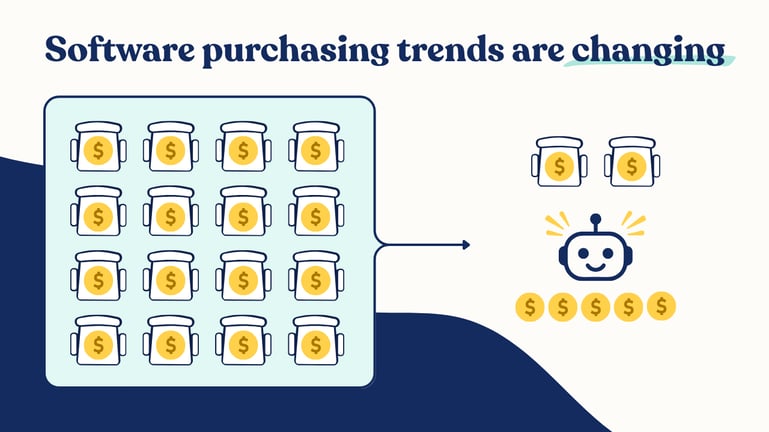
The real story is that spending tied to agents, automation, and AI systems is growing so quickly that traditional per-seat software is becoming a smaller percentage of overall technology spend.
We've experienced this firsthand at Phin.
Over a recent two-month period, we added two additional Enterprise Sales seats in HubSpot. The cost was roughly $250 per month. During that same timeframe, we added approximately $8,000 per month in AI-powered prospecting systems and supporting infrastructure operating within our sales process.
The interesting part isn't that one number is larger than the other. It's that the unit of value has changed. The additional seats gave people access. The AI systems performed work.
Historically, seat count served as a useful proxy for value because human labor was the primary driver of output. As software begins performing larger portions of that work, the relationship between seats and value becomes weaker.
A company can dramatically increase output while adding few, if any, additional employees. In some cases, seat count may remain flat while software usage, customer value, and vendor costs all rise significantly.
The Future of Pricing Looks More Like Outcomes
This shift also helps explain why consumption-based pricing has become so common among AI companies.
Underneath nearly every AI application sits a consumption-based cost structure. Tokens, compute, storage, inference, and infrastructure all create real costs that scale with usage. Eventually, businesses have to align what they charge customers with the economics required to deliver those services.
For many companies, that means moving beyond simple subscriptions.
Some categories will naturally adopt consumption pricing. Others may move toward outcome-based pricing models where customers pay for measurable results rather than access alone.
At first glance, outcome-based pricing sounds radical. In reality, it's often closer to how customers think about value in the first place.
Businesses rarely buy software because they want software. They buy software because they want something the software helps them achieve, whether that's more pipeline, more efficiency, faster response times, better security outcomes, reduced risk, etc.
The closer pricing aligns with those outcomes, the easier it becomes for customers to understand value and for vendors to connect revenue to the impact they create.
What This Means for MSPs
MSPs are already operating in an environment where clients expect more while budgets remain constrained. They want stronger security, faster support, better reporting, greater automation, and lower risk, often without corresponding increases in spending.
AI doesn't change those expectations. It amplifies them.
The MSPs that benefit most from AI won't necessarily be the ones experimenting with the most tools. They'll be the ones that redesign their operations around the leverage those tools create. They'll identify areas where automation can replace repetitive work, free up skilled employees for higher-value activities, and create better outcomes for clients.
Phishing analysis is a good example of this. Most clients don't care how many emails are reported, analyzed, and triaged. They care that the right emails are reported, and that they're triaged as quickly and accurately as possible to help prevent a security breach without wasting time on emails that aren't a threat.
That focus on outcomes is one of the reasons we've spent so much time at Phin automating the process. MSPs don't need another platform that creates additional administrative work. They need systems that help them deliver measurable security outcomes efficiently and at scale.
Of course, the broader trend extends well beyond phishing analysis. As AI continues reducing the cost of execution, software categories across the industry will face increasing pressure to prove the outcomes they create rather than simply justify access.
The businesses that thrive in this environment will be the ones that understand a simple reality: the future isn't built around seats. It's built around systems.
As employees gain leverage through agents and automation, software consumption will increasingly happen through those systems. APIs will become more important, consumption and outcome-based pricing will become more common, and organizations that effectively combine human judgment with AI-driven execution will steadily widen the gap between themselves and their competitors.
That's not a prediction, it's already happening.