
Report phishing buttons have become standard, and instead of ignoring unusual emails, employees are more actively reporting them — which is great!
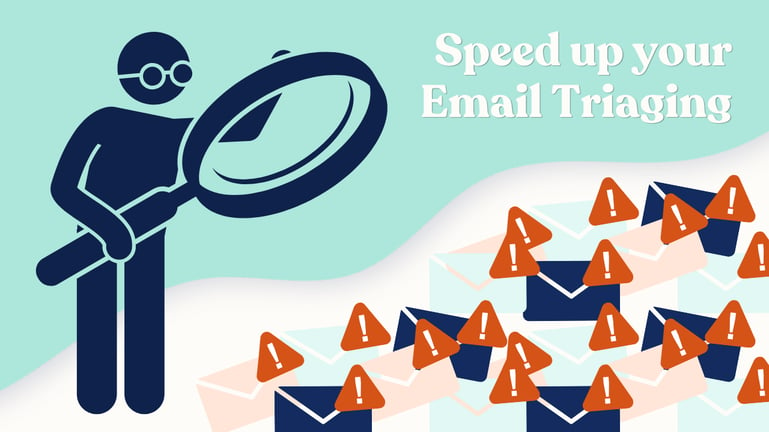
Unfortunately, as phishing awareness improves, MSPs often find themselves buried under an entirely different operational issue: phishing report overload. The very systems designed to improve security visibility can unintentionally create bottlenecks for help desks and security teams.
Most MSPs are prepared for phishing attacks. Fewer are prepared for the sheer volume of reported emails that come with a mature reporting culture.
As phishing emails continue to increase in sophistication and volume, the challenge is no longer just detecting threats. It’s managing the workflow efficiently enough to keep up and make sure nothing malicious is sitting in your clients’ inboxes.
The Hidden Operational Cost of “Report Phishing”
Every MSP wants users to report suspicious emails. A healthy reporting culture reduces risk and increases engagement from end users who may otherwise ignore potential threats.
But once users understand that they should report suspicious emails, many begin reporting everything:
- Marketing newsletters
- Vendor outreach
- Spam emails
- Internal company messages
- Legitimate automated notifications
- Poorly formatted but harmless emails
From the user’s perspective, this behavior makes sense. They’re trying to avoid making the wrong decision. For MSPs, however, every reported email becomes a task that requires investigation.
Even if most reports turn out to be harmless, the workload still exists. Someone has to review the email, validate the sender, inspect headers, check links, determine whether the message is part of a larger campaign, and decide whether remediation is necessary.
Individually, these steps may only take a few minutes. At scale, they become a major drain on engineering resources. (As seen on r/sysadmin)
Why Email Triage Becomes a Bottleneck
Most phishing investigations are not technically difficult, but they’re operationally inefficient.
A typical workflow often looks something like this:
- A user reports an email.
- A ticket is created automatically.
- An L1 technician reviews the report.
- Information is gathered from multiple tools.
- Uncertainty leads to escalation.
- A senior engineer repeats portions of the analysis.
- A final determination is made.
In many environments, this process happens dozens or hundreds of times every week.
The issue is not necessarily a lack of technical expertise. The issue is that phishing analysis is fragmented across multiple systems and relies heavily on manual investigation.
Teams often jump between:
- Email platforms
- Threat intelligence tools
- Header analyzers
- Sandbox environments
- Secure email gateways
- DNS and reputation checkers
- Internal ticketing systems
Every context switch adds time, every manual step introduces potential inconsistency, and every escalation increases the cost of resolving what is frequently a low-risk report.
Escalation Becomes the Default
One of the biggest workflow problems MSPs encounter is unnecessary escalation.
L1 technicians are usually capable of handling many phishing reports, but only if they have enough context to make decisions confidently. Without centralized analysis or standardized guidance, technicians often escalate tickets simply to avoid risk.
That creates several downstream problems:
- Senior engineers spend time on low-priority analysis
- Ticket queues grow larger
- Response times slow down
- Threat prioritization becomes harder
- Operational costs increase
Over time, phishing report management starts consuming resources that should be focused elsewhere. This is especially problematic for MSPs managing multiple tenants simultaneously. A process that feels manageable for one client can quickly become overwhelming across dozens or hundreds of environments.
The Multi-Tenant Problem Most Teams Overlook
Many MSPs unknowingly solve the same phishing problem repeatedly.
A malicious email is identified for one client tenant. The email is removed or blocked. The ticket is closed. But the same sender or campaign may already exist in several other client environments. Without cross-tenant visibility and action capabilities, teams end up performing the same investigation multiple times, creating duplicated effort and delayed response times across the broader customer base.
For MSPs, scalability depends on being able to operationalize threat response across all managed tenants — not just resolve incidents one organization at a time.
5 Things Faster Phishing Triage Actually Requires
Improving phishing response workflows does not necessarily require more staff.
In most cases, it requires fewer manual processes.
Efficient phishing analysis depends on several key improvements:
1. Centralized Context
Technicians should not need to gather data from multiple systems just to assess a single email. Headers, links, sender intelligence, attachment details, and prior campaign history should be visible in one place.
2. Faster Initial Assessment
Teams need a quick way to determine:
- Is this likely malicious?
- Is it already known?
- Does it require escalation?
- Has this appeared elsewhere before?
The faster those questions are answered, the faster queues move.
3. Consistent Decision-Making
Standardized analysis reduces variability between technicians and decreases unnecessary escalations. Consistency also improves documentation and remediation accuracy.
4. Better L1 Enablement
When technicians are given structured analysis and clear indicators, they can independently resolve more tickets. This keeps senior engineers focused on higher-priority work.
5. Cross-Tenant Remediation
Threats should be handled globally whenever possible. If one malicious email is identified, MSPs should be able to remove or block it across all affected tenants immediately.
How Automation Changes the Workflow
Automation becomes valuable when it removes investigation friction rather than simply generating more alerts. Many security tools add additional dashboards, notifications, or complexity without significantly improving workflow efficiency.
The most effective phishing triage workflows reduce:
- Manual investigation time
- Tool switching
- Duplicate analysis
- Escalation frequency
- Multi-tenant repetition
This is where platforms like Phinbox IQ are designed to help.
Instead of forcing technicians to build an assessment manually, Phinbox IQ analyzes reported emails automatically and surfaces the relevant context directly inside the help desk workflow.
That includes:
- AI-driven severity analysis
- Header and sender insights
- Link analysis
- Campaign visibility
- Threat explanations
- Centralized review workflows
By presenting structured analysis immediately, teams can make decisions significantly faster. For many MSPs, that means reducing phishing triage from 15 to 60 minutes per ticket down to just 3 to 5 minutes.
"Phinbox IQ is saving us a ton of time... instead of having to go to five different URLs, we can see everything in one pane of glass." - Matt Collier, Cybersecurity Services Manager at TenHats
More importantly, it allows L1 technicians to handle a larger percentage of tickets independently:
“We were doing everything by hand, now we’ve dropped engineering time by 80 percent… My L1s can handle stuff that used to get escalated to me. This lets me focus on other things.” - Joel Chambers, Escalation Specialist at Certified CIO
Scaling Security Operations Without Increasing Burnout
Operational efficiency matters just as much as detection accuracy.
MSPs cannot realistically hire their way out of phishing report volume forever. As user reporting increases and phishing campaigns become more sophisticated, manual investigation workflows become increasingly difficult to sustain.
The goal should not be reducing user reports. It should be building systems capable of handling those reports efficiently.
When phishing workflows improve:
- Engineers spend less time on repetitive analysis
- Ticket queues move faster
- Threats are prioritized more effectively
- Human error decreases
- Response becomes proactive rather than reactive
Most importantly, MSPs no longer have to choose between strong user awareness and operational efficiency. They can have both!
The Future of Phishing Response
Phishing attacks are not slowing down. AI-generated campaigns, impersonation attempts, and credential harvesting attacks continue to evolve rapidly.
At the same time, users are becoming more aware and more likely to report suspicious activity.
That combination creates a new operational challenge for MSPs: scaling phishing responses without overwhelming internal teams.
The MSPs that adapt successfully will be the ones that streamline triage, reduce investigation friction, and operationalize response across all tenants. At a certain point, phishing analysis stops being purely a security problem, and becomes a workflow problem.
Want to remove phishing analysis bottlenecks for your engineers? Talk to Phin about implementing Phinbox IQ right into your help desk.