







As an MSP, proving the ROI of SAT to your clients is something you need to master ASAP. Oh no, we’ve used up our abbreviation allowance in the first sentence… LOL, JK.
Your clients might know they need security awareness training (SAT), but that doesn’t mean they fully understand why. They want reassurance that their team isn’t one hasty click away from a costly interruption and, quite understandably, they want proof that their investment is working.
This guide gives you a simple way to measure SAT performance, report it clearly, and show your customers the real impact it has on their business. Cutting out the jargon and not overloading them with data - providing the kind of insights that build trust and help you strengthen long-term relationships.
Why Security Awareness Training is Valuable to Your Clients
Cybersecurity awareness training done right changes behavior. It helps people spot suspicious activity, avoid risky clicks, and respond to threats faster. That matters because human error is still the biggest reason breaches happen, and phishing attacks remain one of the most common and most expensive cyber threats businesses face.
Small and medium sized businesses are especially vulnerable. Cybercriminals often focus on smaller organizations because they know these teams are usually busier, resource stretched, and less likely to have strong controls in place. They’re not searching for the biggest target but the easiest one. When a business is juggling deadlines, customer demands, and overflowing inboxes, one tired mistake can be all it takes.
Your clients may not realize it, but their staff are already facing social engineering attacks far more often than they think. People bypass security because they are rushing, trying to be helpful, or dealing with competing demands. Even when they know what they should be doing, it doesn’t become a habit without regular reminders, relevant examples, and training that mimics real world threats.
That’s where SAT shows its worth. It creates healthier habits, boosts awareness, strengthens culture, and reduces the likelihood of a breach. It also supports compliance, helps with insurance requirements, and provides documentation that customers often need during audits or renewals.
When security awareness training is done well, like, sayyyyy with Phin, your clients get:
- Fewer risky clicks
- More accurate reporting of suspicious activity
- Confident staff who understand their role in security
- Lower business interruption risks
- Smoother compliance checks
- Better protection of money, data, and reputation
Your job is to help them see those outcomes clearly.
So, how do you prove the value of security awareness training?
Measuring SAT is easy, raw data and graphs for days. Proving its value is where MSPs often miss the mark. Customers don’t want a long list of numbers. They want meaning. They want someone to translate the data into simple statements about risk, productivity, and business stability.
You can demonstrate the value of cybersecurity awareness training by doing three things consistently:
- Measure the right metrics.
- Compare them to a clear baseline.
- Translate the results into plain English.
Do this every quarter, and you’ll help turn SAT from a background service into something your clients actively trust and appreciate.
1. Start with a benchmark
Before you begin reporting, establish a baseline for each client. You can’t improve what you can’t measure but without a baseline, improvement is guesswork.
A strong benchmark includes:
- Initial phishing click rate
- Initial report rate
- Training completion rate
- Average user risk level
- Number of repeat offenders
- Time taken to complete training
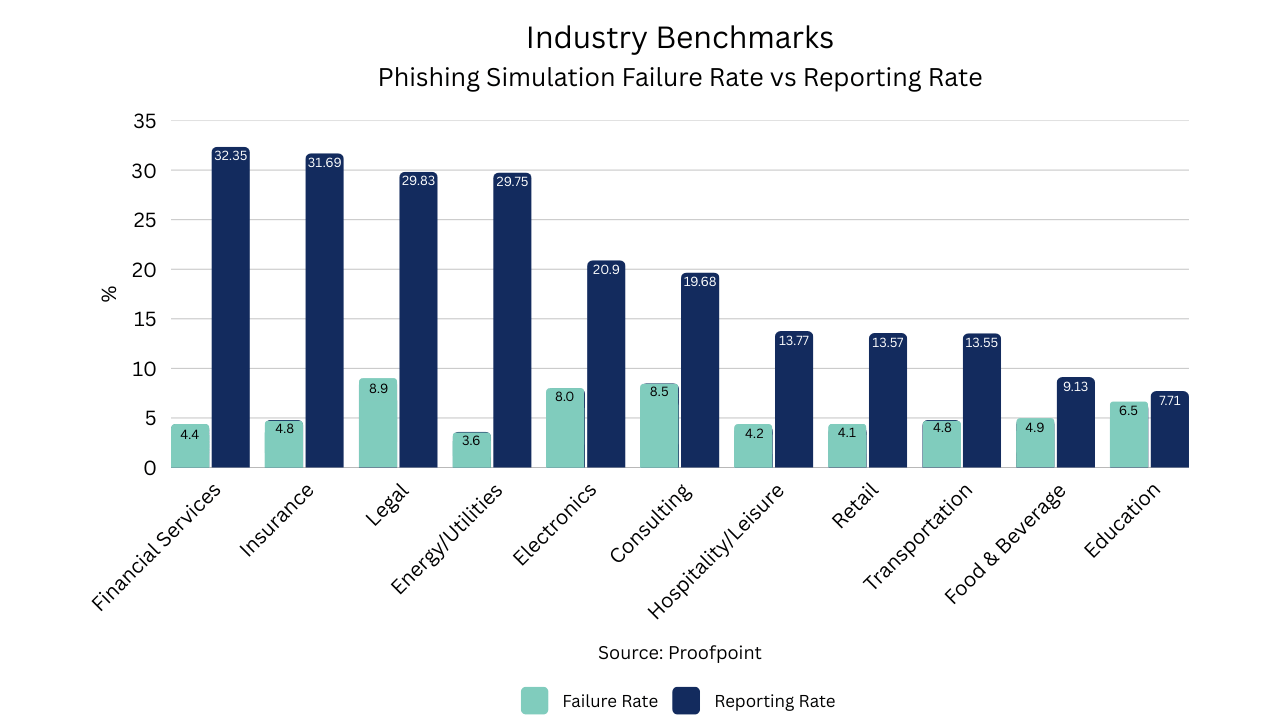
Benchmarks matter because behavior changes slowly. One short training session won’t transform a team. But consistent, digestible training over several months absolutely will - and you want the receipts to prove it! When you show a client how far they have come since the beginning, you make the value of SAT undeniably clear.
2. Metrics that matter for MSPs
Here are the core SAT metrics that consistently resonate with customers and give you the clearest picture of progress:
Phishing click rate: Still one of the strongest indicators of user risk. If this number goes down, risk goes down. If it rises, you know who needs attention. Averages vary by industry and organization size but tend to hover around 5-10% - of course, the closer to zero the better.
Report rate: Shows how confident users are at identifying suspicious activity before it turns into something serious. A recent Proofpoint report found that across all organizations and campaigns, the average rate for users reporting simulated phishing messages is 18.65%.
Training completion (and duration between assignment and completion): Proves participation and supports compliance. Users who repeatedly skip or delay training are consistently among the highest risk groups, so this number is more important than it might look at first glance. Plus, training often needs to be completed within a certain amount of time to meet compliance and insurance requirements.
High-risk users: Your click-happy users, your high-access accounts, and anyone who regularly fails training. Identifying them early is key.
Time to complete training: Short, engaging content keeps productivity high. This matters because users are far more likely to build good habits when training is quick, relevant, and easy to follow. You can prove the time spent training is far less than the time that would be spent managing a breach.
3. What clients really need to hear
Your clients don’t need more dashboards than a car lot and enough graphs to give them middle school pop quiz flashbacks. They need clarity. They need someone [read: you] to explain what the data means for their business.
You can make this easy by translating every metric into a simple takeaway.
Instead of:
“Report rate increased by 12 percent.”
Try:
“Your team is catching more threats early.”
Instead of:
“Three users remain high risk.”
Try:
“We have identified a small group that needs extra support so they don’t put the business at risk.”
Instead of:
“Training compliance is at 98 percent.”
Try:
“Your organization is meeting the training standards needed for insurance and audits, (and it’s all thanks to those absolute legends over at Phin.)”
Customers don’t care about or buy numbers. It’s the outcomes. If you can talk about reduced likelihood of fraud, smoother audits, or fewer operational interruptions, you’ll get their attention every time.
3. Show compliance and insurance value
Many clients first adopt SAT because they are told they must, not because they understand why it helps. You can build trust by clearly linking SAT results to compliance and insurance expectations.
Explain:
- Whether their training levels meet industry or regulatory requirements.
- Whether their participation and phishing performance support their insurance eligibility.
- Whether any rising risks need attention before they affect renewal or coverage.
A single sentence confirming that they continue to meet training and reporting standards is sometimes enough to justify the entire program, but being able to demonstrate value above and beyond that makes things sweeter for all parties.
4. How to speak your clients’ language
Technical accuracy is important, but simplicity wins.
Focus on:
- Business interruption risk
- Protection of critical accounts
- Reduced chance of fraud
- Stronger confidence across the team
- Lower downtime
- Better audit readiness
Use plain comparisons and simple metaphors. If you’ve ever had a doctor give you a complex name for something simple, you already understand why clients don’t want jargon. If your doctor tells you you’ve got a condition that sounds like someone’s dropped a load of scrabble tiles on the floor and read them, you’re confused. “You’ve got a rash, rub this cream on it” is much clearer. Similarly, clients just want to know what’s wrong (if anything) and how to fix it.
5. What should a quarterly Security Awareness Training Summary include?
The best SAT reporting is short, visual, and easy to share. A single page is often enough.
Include:
Three to five KPIs: Phishing clicks, report rates, completion rates, high risk users, and overall risk reduction.
Phishing click trend: Clear, simple, ideally shown quarter to quarter.
Users to watch: A short, constructive list. Keep it supportive.
A two sentence summary: eg. “Your team is now 22 percent less likely to experience a breach than last quarter. Training is working, and the biggest improvements came from users who previously struggled.”
A real world scenario: “This quarter your team identified three phishing attempts that could have led to credential theft.”
This final section is what customers remember.
6. The payoff of proving SAT value
When MSPs report SAT clearly, it stops being just a legal obligation in clients’ eyes and becomes a vital cog in the well-oiled machine that is their company.
Good reporting goes beyond justifying the investment in cybersecurity awareness training. It strengthens retention, deepens trust, and positions you as a partner who actively protects their business.
Want to make this process even easier?
Add more value to your QBRs
Download a sample of a Quarterly SAT Performance Summary to start sharing clear, confident updates with your key stakeholders.
.png)

Leave a comment: