

"Can AI be trusted to analyze phishing emails?" It's a fair question.
After all, nobody wants to hand their security operations over to a glorified chatbot and hope for the best. Millennials may remember SmarterChild fondly, but hopefully nobody trusted it with their security operations.
The real question might not be whether AI can analyze reported emails, though. You should be considering whether AI can help your team analyze them faster, more consistently, and more efficiently than they can on their own, because for many MSPs, reported email investigations have become a growing operational challenge.
Security awareness training is working. Users are reporting suspicious emails more frequently than ever. That's great for security, but it also means technicians are spending more time reviewing messages that often turn out to be harmless.
AI-powered phishing analysis tools have emerged as a potential solution, but not all AI is created equal. Understanding where AI excels, where it falls short, and how it should fit into the investigation process is the key to determining whether it's something your team can trust.
Why Reported Email Queues Keep Growing
For years, security awareness programs focused on encouraging users to report suspicious emails. The advice was simple: if something feels off, report it. That's exactly what users are doing.
Employees now report phishing attempts, suspicious attachments, unexpected invoices, strange login requests, and sometimes perfectly legitimate emails that simply arrived at an unfortunate moment. If you've ever seen a user report a company newsletter they willingly subscribed to six months ago, you're not alone.
The problem isn't that users are reporting too much, it’s that every report creates work.
Each email needs to be reviewed, classified, documented, and, if necessary, escalated. What starts as a positive security habit can quickly become an operational burden, particularly for MSPs managing multiple clients. As reporting rates increase, so does the workload associated with investigating those reports. That's where many security teams find themselves today.
The Hidden Cost of Manual Email Triage
Most email investigations follow a similar process.
A technician reviews the sender, checks links, examines headers, evaluates authentication results, looks for signs of impersonation, and determines whether the email presents any real risk. None of those tasks are particularly difficult in isolation - the challenge is volume.
When dozens or hundreds of reported emails arrive every week, even short investigations begin consuming significant amounts of time.
Those hours come with real costs:
- Increased labor expenses
- Longer investigation queues
- Delayed responses to genuine threats
- Analyst fatigue
- Reduced time for higher-value security work
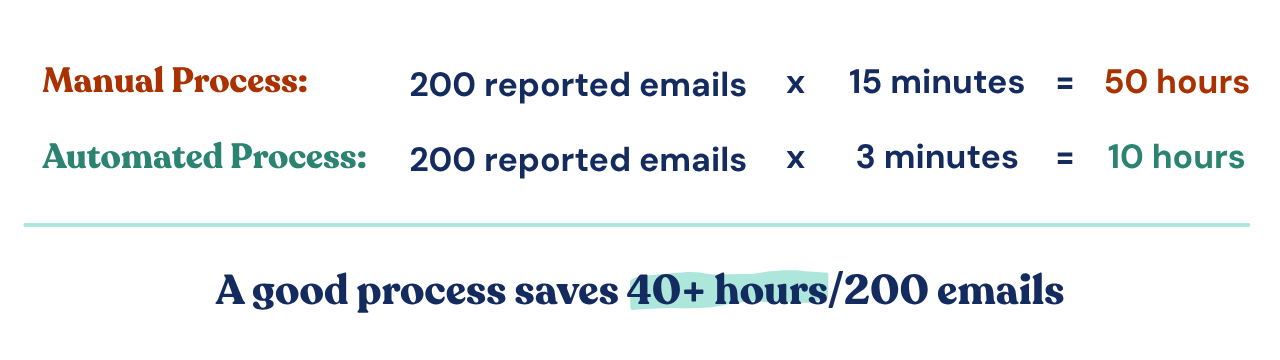
Many reported emails ultimately turn out to be harmless. Unfortunately, technicians don't know that until they've spent time investigating them. This creates a situation where highly skilled security professionals are often performing repetitive analysis on emails that pose little or no risk. That isn't the best use of their expertise.
Learn how to scale phishing analysis without hiring more people.
Not All AI Is Created Equal
One challenge when discussing AI phishing analysis is that people often treat AI as if it's a single technology. It isn't. Asking whether AI can accurately analyze phishing emails is a bit like asking whether software can manage a business. Firstly, it depends what software you’re talking about. Secondly, the right software could help a human run a business, but we’re not quite yet in a dystopian future where robots are buying and selling to each other and us meatbags are just sitting irrelevant on the sidelines.
A general-purpose AI assistant can often identify obvious phishing indicators and explain why an email appears suspicious. That's impressive and genuinely useful in many situations. However, a purpose-built phishing analysis platform is solving a very different problem.
Security-focused AI systems are designed specifically for email threat analysis. They're built to evaluate authentication results, identify impersonation attempts, analyze suspicious URLs, assess risk indicators, and support investigation workflows.
Just as importantly, they're designed to operate within a security team's existing processes. So, specialization is an even bigger differentiator between AI systems than levels of “intelligence.”
What AI Is Actually Good At
AI's greatest strength is handling repetitive tasks at scale, rather than replacing human analysts. Modern phishing analysis tools are exceptionally good at identifying patterns and indicators that security professionals already look for during investigations.
For example, AI can quickly evaluate:
- Suspicious sender domains
- Lookalike email addresses
- Credential harvesting indicators
- Malicious or suspicious URLs
- Spoofing attempts
- Social engineering tactics
- Urgency language
- Requests for sensitive information
Rather than manually checking each of these elements one at a time, AI can assess them simultaneously in seconds. Consistently.
Unlike humans, AI doesn't get distracted, tired, or rushed because there's a growing queue waiting for review. That's not a criticism of analysts, just the reality of human workloads. Consistency becomes increasingly valuable as investigation volumes increase.
Can You Trust AI to Analyze Reported Emails?
The short answer is yes. The longer answer is yesssssssssss. Nah, only joking. The long answer is “yes, but maybe not in the way you imagine.”
AI shouldn’t be viewed as an infallible decision-maker, but an investigation accelerator.
Modern AI is remarkably effective at identifying common phishing techniques and surfacing important indicators. In many situations, it can perform an initial review far faster than a human analyst.
That doesn't mean it's perfect. False positives still happen. Legitimate emails may occasionally be flagged as suspicious. False negatives can happen as well. Dangerous emails may sometimes appear harmless. But we’re not comparing AI to perfection here because human analysts aren’t perfect. We’re comparing AI-assisted analysts to analysts working on their own. When viewed through that lens, AI often becomes much easier to trust.
Why Severity Ratings Matter More Than Safe or Malicious
One of the biggest misconceptions about phishing analysis is that every email falls neatly into one of two categories:
-
Safe
-
Malicious
Real-world investigations are rarely that straightforward. Many reported emails contain suspicious characteristics without representing an immediate threat. Others may appear harmless at first glance while containing indicators that warrant further investigation.
That's why severity ratings are often more useful than simple verdicts.
Instead of providing a binary answer, modern phishing analysis platforms can assign risk levels and explain the reasoning behind them.
For example:
-
Low Severity: Marketing email or legitimate business communication
-
Medium Severity: Unexpected sender or suspicious indicators requiring review
-
High Severity: Likely phishing attempt involving malicious links or credential harvesting
-
Critical Severity: Active impersonation attack or business email compromise attempt

This approach helps analysts prioritize their workload more effectively, because not every reported email deserves the same level of attention.
How Phinbox IQ Uses AI to Prioritize Investigations
At Phin, we believe the purpose of AI is to help humans do their jobs more effectively, rather than replacing them. Phinbox IQ uses AI-generated severity ratings to help MSPs prioritize reported emails and identify higher-risk threats faster. Instead of forcing technicians to manually gather information from multiple tools, Phinbox IQ surfaces the context they need directly within the helpdesk workflow.
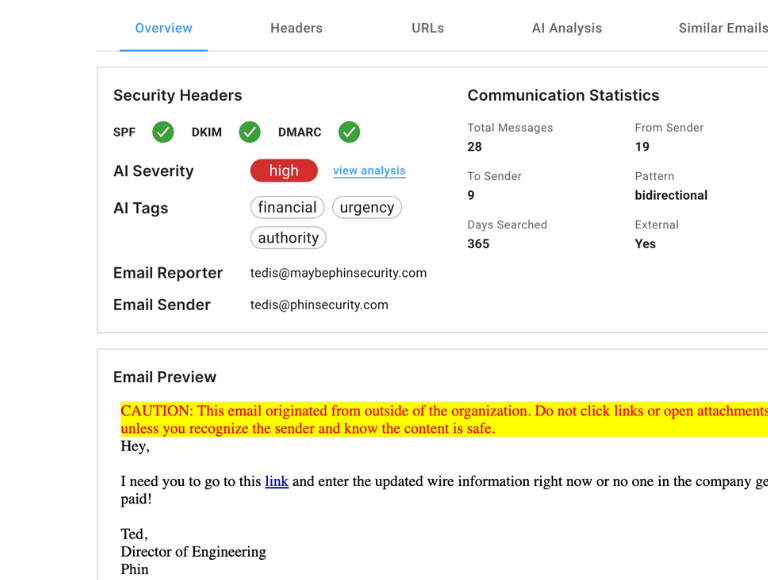
That means investigators can quickly understand:
- Why an email was flagged
- Which indicators contributed to the assessment
- How severe the potential threat may be
- Whether further investigation is required
Even when a technician chooses to independently validate the AI's assessment, they can do so far more efficiently because the relevant information is already available. The result is faster, better-informed investigations, rather than blind trust in AI.
"You've reduced the human error rate... not just on the end user side, but also on the engineer side." - Joel Chambers, Escalation Specialist at Certified CIO
When Human Review Still Matters
AI can significantly reduce investigation workloads, but there are situations where human expertise remains essential.
Examples include:
- Executive impersonation attempts
- Business email compromise investigations
- Financial fraud incidents
- Regulatory or legal matters
- Sophisticated social engineering attacks
These scenarios often require business context, organizational knowledge, and decision-making capabilities that extend beyond the contents of a single email. As such, human analysts remain critical to the investigation process. The difference is that AI can help ensure they spend their time on the investigations that genuinely require their expertise.
So, should you let AI analyze your reported emails? Absolutely. Just make sure it’s the right AI, and don't expect it to replace your security team. To learn more about Phinbox IQ, check out this case study where an MSP saved 50+ hours per week on phishing analysis.