








For years, cybersecurity strategies focused almost entirely on technology. Businesses invested in firewalls, antivirus software, endpoint detection, email filtering, and multi-factor authentication to keep attackers out. Those tools remain essential, but today's cybercriminals have recognized that it's often easier to manipulate a person than it is to break through well-configured security controls.
Instead of trying to hack their way into an organization, attackers increasingly rely on phishing emails, social engineering, business email compromise, and other techniques designed to persuade employees to give them access voluntarily. A convincing email requesting a password reset or a fake invoice from what appears to be a trusted supplier can bypass even the most sophisticated technical defenses if someone believes it's genuine.
That's why Security Awareness Training has become one of the most important investments an organization can make.
Rather than treating employees as the weakest link, effective Security Awareness Training helps turn them into an active part of an organization's security strategy. It teaches people how modern cyberattacks work, what warning signs to look for, and how to respond safely when something doesn't seem right. The goal isn't to make every employee a cybersecurity specialist. It's to help ordinary people make better security decisions during their everyday work.
For managed service providers (MSPs), Security Awareness Training has also become an increasingly valuable service offering. It helps clients reduce cyber risk, supports cybersecurity compliance initiatives, satisfies many cyber insurance requirements, and creates recurring revenue opportunities that strengthen long-term customer relationships.
We're here to explain what Security Awareness Training is, what it includes, why every organization should consider it, how to choose the right platform, and how to measure whether it's actually changing employee behavior. Whether you're an MSP evaluating new security services or a business leader looking to improve your organization's cyber resilience, this guide will help you understand what modern Cybersecurity Awareness Training should look like.
What Is Cybersecurity Awareness Training?
Security Awareness Training is an ongoing program that teaches employees how to recognize, avoid, and respond to cybersecurity threats. That definition sounds simple, but it's worth emphasizing one word: ongoing.
Many organizations still think of Cybersecurity Awareness Training as something employees complete once a year to satisfy a compliance requirement. They watch a collection of videos, answer a short quiz, receive a certificate, think of it as a morning off work, and don't think about cybersecurity again until the following year. Modern Security Awareness Training takes a very different approach.
Cyber threats change constantly; attackers adapt their techniques, exploit current events, and take advantage of new technologies to make their scams more convincing. A training program that hasn't evolved in several years is unlikely to prepare employees for today's threat landscape, let alone tomorrow's. Effective Security Awareness Training recognizes that cybersecurity isn't simply a technical challenge. It's a human one.
Most successful cyberattacks don't happen because an attacker discovered an unknown software vulnerability. They happen because someone trusted an email they shouldn't have trusted, approved a payment without verifying it, entered credentials into a convincing fake website, or shared sensitive information with someone pretending to be a colleague.
Security Awareness Training helps employees recognize these situations before they become security incidents.
Just as importantly, it encourages a culture where people feel comfortable slowing down, asking questions, and reporting suspicious activity. That cultural shift is often just as valuable as the knowledge employees gain through the training itself.
Organizations with mature Cybersecurity Awareness Training programs don't expect employees to catch every phishing email or prevent every attack. Instead, they aim to reduce risk by helping people identify suspicious behavior earlier, make more informed decisions, and report potential threats quickly enough for IT teams to investigate.
Good Security Awareness Training isn't about turning everyone into a cybersecurity expert. If Amanda from accounting or Will in Marketing suddenly start asking to perform penetration tests, you've probably overachieved.
What Does Security Awareness Training Include?
Security Awareness Training has evolved significantly over the last decade. While compliance requirements helped drive its early adoption, modern programs focus much more heavily on changing behavior than simply delivering information.
Today's platforms typically combine several different learning methods that reinforce one another throughout the year.
Educational Modules
Most programs begin with short educational modules covering the cyber threats employees are most likely to encounter. Phishing usually receives the greatest attention because it remains one of the most common ways attackers gain initial access to organizations, but effective training also covers topics such as:
- Password security
- Multi-factor authentication (MFA)
- Business email compromise (BEC)
- Social engineering
- Data handling
- Remote working
- Safe internet browsing
- Mobile device security
- Emerging threats like AI-generated scams
We’ve covered the most important topics of 2026 here.
The format of that training matters just as much as the content itself.

Few employees look forward to sitting through hour-long cybersecurity presentations filled with technical terminology that has little relevance to their role. Modern Security Awareness Training platforms (the good ones) instead favor short, engaging lessons that fit naturally into the working day. Videos, interactive exercises, real-world scenarios, and knowledge checks all help reinforce learning without overwhelming users.
Phishing Simulations
Rather than simply explaining what phishing looks like, organizations send employees phishing simulations - realistic but harmless phishing emails designed to mimic the kinds of attacks criminals use every day. These simulations might imitate Microsoft 365 password reset requests, package delivery notifications, HR announcements, invoice approvals, or messages from senior executives.
If an employee clicks a simulated phishing link or enters their credentials, no harm is done. Instead, if the training is done well, they're shown what warning signs they missed and how to identify similar attacks in the future. The experience becomes a practical learning opportunity rather than a costly security incident.
When delivered appropriately, phishing simulations aren't designed to embarrass employees or catch them making mistakes. Their purpose is to build confidence. Employees learn that it's perfectly acceptable to question unusual requests, verify unexpected emails, and report anything that doesn't seem quite right.
The strongest Security Awareness Training programs (naming no names, cough, Phin) also recognize that learning shouldn't stop once a training module has been completed. Short reminders, security newsletters, timely updates about emerging threats, and regular phishing simulations help keep cybersecurity visible throughout the year. These smaller interactions reinforce good habits without disrupting productivity.
Ultimately, Cybersecurity Awareness Training isn't measured by how much content employees consume. It's measured by whether they make better security decisions when it matters most. Learn how to measure your Security Awareness Training program here.
Why Security Awareness Training Matters
If cybercriminals were still sending emails claiming you'd inherited millions from a distant relative, Security Awareness Training probably wouldn't need to be particularly sophisticated.
Unfortunately, those days are largely behind us.
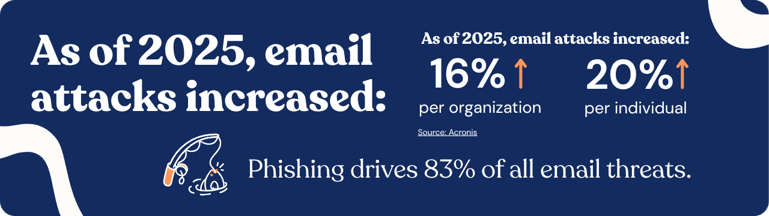
Modern phishing emails often contain perfect grammar, professional branding, and convincing language generated with the help of artificial intelligence. Attackers research organizations before launching campaigns, impersonate trusted suppliers, compromise legitimate business accounts, and tailor messages to specific individuals or departments. In many cases, the email itself contains no obvious warning signs.
Cybercriminals have also become remarkably good at exploiting human psychology.
Rather than relying on technical expertise, they create situations that encourage people to act before they think. Urgent payment requests, unexpected document shares, fake security alerts, and last-minute changes to banking details all rely on familiar emotions like trust, curiosity, authority, or urgency.
Technology can reduce the likelihood of these attacks reaching employees, but it can't eliminate the risk entirely. Email security filters don't catch every malicious message. Multi-factor authentication doesn't prevent someone approving a fraudulent payment. Endpoint protection can't stop an employee voluntarily entering their password into a convincing fake login page. Security Awareness Training fills that gap.
It helps employees understand not only what an attack looks like but why it works. Once people recognize the psychological tactics attackers rely on, they're far more likely to pause before responding to unexpected requests or sharing sensitive information.
Another benefit that's often overlooked is the impact Cybersecurity Awareness Training has on organizational culture.
Employees who understand cybersecurity are more likely to report suspicious emails, ask questions when something feels unusual, and discuss potential threats openly with colleagues and IT teams. Instead of cybersecurity being viewed as someone else's responsibility, it becomes something everyone contributes to.
That shift in mindset is difficult to measure, but it's one of the reasons organizations with mature Security Awareness Training programs often respond more effectively when genuine threats emerge.
Who Needs Security Awareness Training?
The simple answer is that almost every organization can benefit from Security Awareness Training.
If employees use email, access cloud applications, handle customer information, process financial transactions, or communicate with external contacts, they can become targets for phishing and social engineering attacks. That applies just as much to a business with twenty employees as it does to a global enterprise with thousands.
Small and medium-sized businesses sometimes assume cybercriminals only pursue large organizations with valuable intellectual property or substantial financial resources. In reality, attackers often look for organizations they believe will be easier to compromise. Smaller businesses may have fewer dedicated security resources, less formal training, and fewer processes for verifying suspicious requests, making them attractive targets. Like how a low level criminal is more likely to attempt to rob a gas station than a bank - the potential pay off is lower, but the chance of getting away with it is much higher.
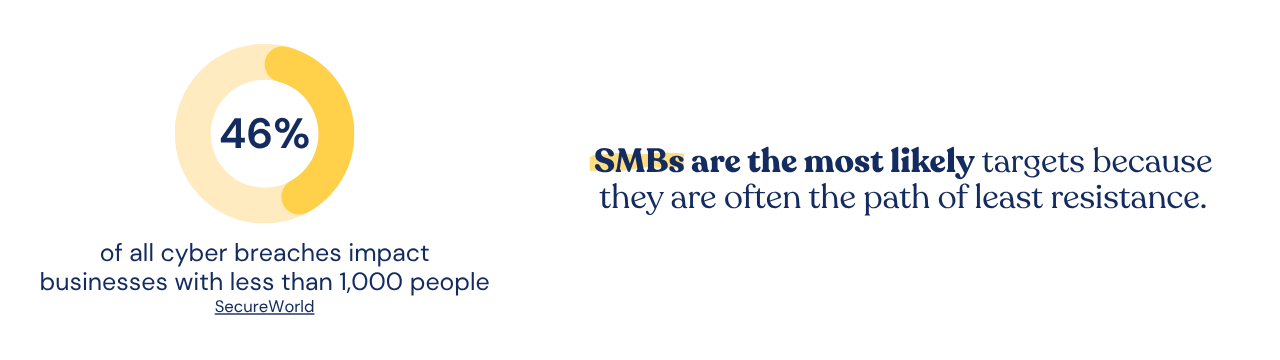
As organizations grow, the challenge changes rather than disappears.
Larger workforces mean more email accounts, more cloud services, more suppliers, and more opportunities for attackers to exploit human error. Ensuring every employee receives consistent, relevant Security Awareness Training becomes increasingly important, particularly when teams are spread across multiple locations or work remotely.

MSPs have perhaps the greatest opportunity of all.
Rather than helping a single organization improve its security posture, MSPs can deliver Security Awareness Training across dozens or even hundreds of clients. That allows them to provide a more complete managed security offering while helping customers reduce phishing risk, improve compliance, and strengthen their overall security culture.
There's also a practical benefit that many MSPs quickly notice.
Organizations with well-trained employees often generate fewer preventable security incidents. Users become more confident identifying suspicious emails, reporting potential phishing attempts, and questioning unusual requests before they escalate into major problems. While no training program can eliminate human error entirely, improving employee awareness can significantly reduce the number of avoidable incidents that require urgent investigation.
Security Awareness Training isn't reserved for highly regulated industries or organizations with dedicated cybersecurity teams. It's become a fundamental part of modern cybersecurity because every organization relies on people, and people continue to be one of the most common targets for cybercriminals.
What Does Good Security Awareness Training Look Like?
We toyed with the idea of simply linking to our testimonials page to answer that question, but we’ll talk you through it properly instead:
Not all Security Awareness Training programs deliver the same results. Two organizations may both provide employees with training throughout the year, yet one develops a genuine security culture while the other simply creates another item on the compliance checklist.
The difference usually comes down to purpose.
Behavior Change
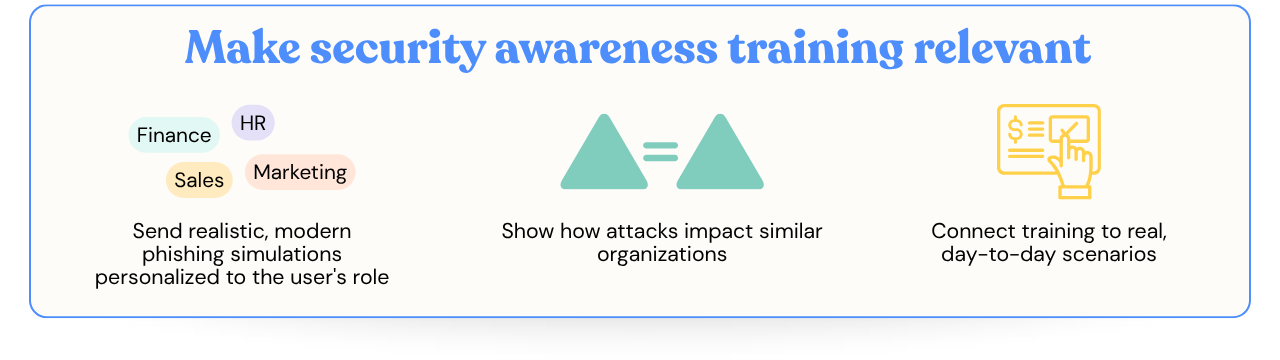
Good Security Awareness Training is designed to change behavior, not just distribute information. It helps employees build practical habits they can apply every day, rather than asking them to memorize technical concepts they'll rarely use. Employees don't need to understand how malware is engineered or how encryption algorithms work. They need to know how to recognize a suspicious email, verify an unusual request, and feel confident reporting something that doesn't seem right.
That means relevance is essential.
The most effective training reflects the threats employees are actually likely to encounter. A finance team may benefit from additional guidance around invoice fraud and payment diversion scams, while HR professionals are more likely to encounter phishing emails disguised as job applications or employee documentation. Executives often face impersonation attacks, while customer-facing teams may be targeted through fake support requests or account verification emails.
Monthly Training
Good Security Awareness Training also recognizes that learning isn't a one-time event.
Cybersecurity changes constantly, and training should evolve alongside it. New phishing techniques emerge, attackers adopt new technologies, and major news stories often become opportunities for social engineering campaigns. Organizations that update their training regularly are far better positioned to prepare employees for current threats than those relying on the same content year after year.
Realistic & Relevant
Another hallmark of effective training is realism.
Phishing simulations should look like genuine emails employees might actually receive. If every simulated phishing email is filled with spelling mistakes and suspicious links, employees aren't learning how to identify modern attacks. They're learning how to identify outdated examples.
Positive Reinforcement
Perhaps most importantly, good Security Awareness Training encourages curiosity rather than fear.
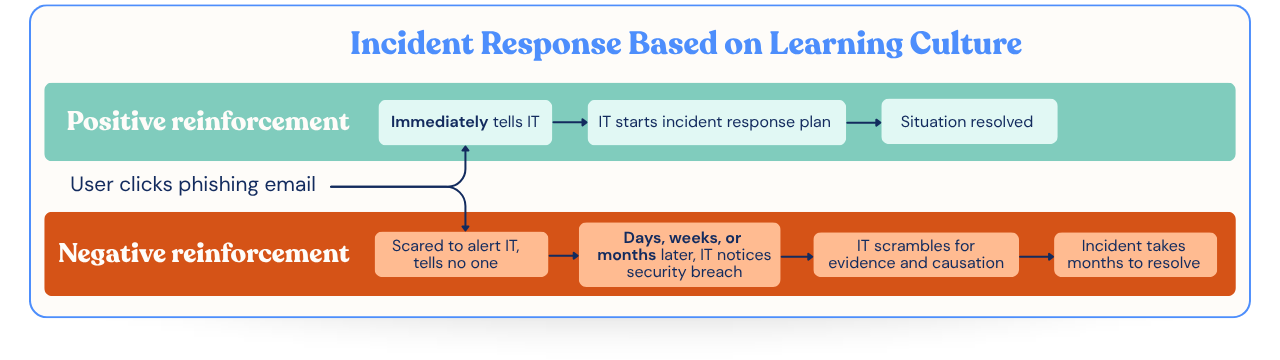
Employees shouldn't worry about being embarrassed if they report a legitimate email or make a mistake during a phishing simulation. The organizations that see the greatest long-term improvements are those where employees feel comfortable asking questions and reporting anything unusual without worrying they'll be criticized for doing so.
If your employees are nervous about reporting suspicious emails because they're afraid of "getting it wrong," that's a bit like telling someone not to see a doctor for their chest pains because there’s a chance it’s just reflux - it’s better to be safe than sorry!
Check out the 6 best practices for security awareness training.
What Poor Security Awareness Training Looks Like
Just because everyone completes the assigned course, reports show excellent participation rates, and the compliance requirement is satisfied for another year, doesn’t mean the training is changing behavior. Unfortunately, cybercriminals don't care how many certificates your employees have earned.
Annual Training
The most common weakness is treating Security Awareness Training as an annual event instead of an ongoing process. Employees complete several hours of training during a single afternoon, retain a fraction of the information, and gradually forget much of it before the next year's session arrives. Content can also become outdated surprisingly quickly.
Attack techniques evolve far faster than many training programs. Material that was highly relevant a year ago may no longer reflect the phishing campaigns employees receive today. If the examples feel unrealistic, employees naturally begin assuming real attacks will be equally obvious.
Measure Completion
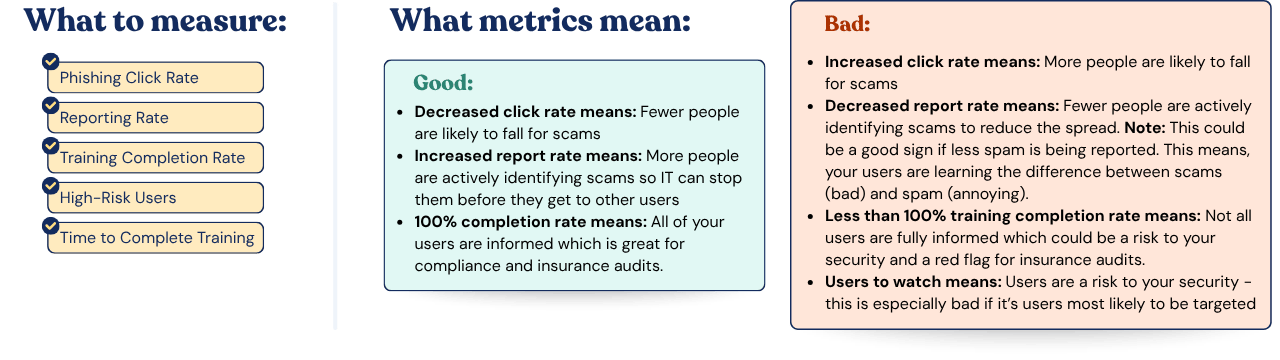
Poor programs also tend to focus on completion rather than improvement. Finishing a course doesn't necessarily mean someone understands the material or will apply it in a real-world situation. Organizations that only monitor completion rates have very little visibility into whether employee behavior is actually changing over time.
Negative Reinforcement
Finally, ineffective Cybersecurity Awareness Training often treats mistakes as failures instead of opportunities to learn. Every phishing simulation should leave employees better prepared than they were before. If people become afraid of making mistakes or reporting suspicious activity, the training has created a cultural problem rather than solving one.
Security Awareness Training, Compliance, and Cyber Insurance
Many organizations first explore Security Awareness Training because of compliance requirements or cyber insurance questionnaires. Numerous cybersecurity frameworks recognize that employee awareness is an important part of reducing organizational risk. Standards such as ISO 27001, Cyber Essentials, PCI DSS, HIPAA, and NIS2 all place varying levels of emphasis on educating employees about cybersecurity and establishing appropriate security practices.
Similarly, cyber insurance providers increasingly ask organizations how they prepare employees to recognize phishing attacks, protect credentials, and respond to suspicious activity.
These questions aren't simply administrative exercises. Insurers understand that many successful cyberattacks begin with human error. Organizations that provide regular Security Awareness Training are generally better equipped to recognize threats early, reducing both the likelihood and potential impact of a security incident.
With that said, compliance should never be the primary objective.
An organization can satisfy a compliance requirement while still delivering training that has little impact on employee behavior. Likewise, a business with an excellent Security Awareness Training program will often find that compliance becomes significantly easier because many of the required practices are already part of everyday operations.
The goal shouldn't be to pass an audit, but to reduce risk. If your training accomplishes that, compliance and cyber insurance requirements often become much easier to satisfy.
How to Choose the Right Security Awareness Training Platform
Most vendors promise engaging content, realistic phishing simulations, comprehensive reporting, and measurable results. While many platforms share similar core features, the experience of delivering and managing training can differ considerably.
Download the “Security Awareness Training Buyer’s Guide.”
1. Content quality
Is it regularly updated to reflect current threats? Does it explain concepts clearly without overwhelming employees with technical jargon? Is it engaging enough that people are likely to pay attention rather than simply clicking "Next" until the course ends and they can have a donut?
The best platforms allow organizations to deliver realistic campaigns that reflect the types of attacks employees are genuinely likely to receive. They should also make it easy to reinforce learning immediately after a simulation, helping employees understand what warning signs they missed rather than simply informing them they clicked the wrong link.
2. Reporting quality and ease of access
Beyond tracking completion rates, a good platform should help organizations understand how employee behavior changes over time. Are phishing simulation click rates decreasing? Are employees reporting more suspicious emails? Which departments may need additional support? These insights are far more valuable than a simple list of completed courses.
3. Administrative Overhead
Managing Security Awareness Training across multiple clients and/or end-users shouldn't require hours of repetitive manual work. Features such as multi-tenancy, shared campaigns, centralized reporting, and automation make it possible to deliver consistent training efficiently while reducing administrative overhead.
4. Platform Improvements
Cybersecurity continues to evolve rapidly, and your training platform should evolve with it. Choosing a provider that regularly updates its content, introduces new capabilities, and responds to changes in the threat landscape helps ensure your Cybersecurity Awareness Training remains effective for years to come.
How to Measure the Success of Security Awareness Training
As mentioned previously, one of the biggest mistakes organizations make is assuming Security Awareness Training can be measured by completion rates alone.
Completion certainly matters. If employees aren't participating in training, it's difficult to expect meaningful improvements in cyber habits. However, completing a course simply shows that someone has finished the assigned material. It doesn't tell you whether they'll recognize a sophisticated phishing email next week.
The strongest Security Awareness Training programs measure behavioral change instead. Phishing simulations provide one of the clearest indicators of progress. Over time, organizations should expect to see:
- Fewer employees clicking suspicious links
- Fewer credentials submitted through simulated phishing pages
- More users successfully identifying and reporting suspicious emails
When employees become more security conscious, they naturally report more messages for review. While this can initially increase the workload for IT teams, it also demonstrates that employees are actively looking for threats rather than ignoring them.
Organizations should also monitor broader trends over time:
- Are employees reporting suspicious activity more quickly?
- Have successful phishing incidents become less frequent?
- Are conversations about cybersecurity becoming more common throughout the business?
These indicators paint a much more complete picture than training completion alone. Ultimately, the success of Security Awareness Training isn't measured by how much employees know, but by what they do differently because of what they've learned.
If your biggest problem is that employees keep reporting perfectly legitimate marketing emails, you're in a better position than the organization where nobody reports anything at all. (And there’s a way to reduce the extra time spent on phishing analysis that may develop from more reported emails.)
Ready to Strengthen Your Security Culture?
Technology can block many attacks, but informed employees remain one of the strongest defenses against phishing and social engineering.
Download our “Security Awareness Training Buyer’s Guide” to know exactly what your organization needs from a provider and which provider is right for you and your end-users.



Leave a comment: