



Skip to content

Read Our Blog

If you have any questions or would like us to cover a specific topic, please reach out and let us know.

Understanding Cyber Insurance Requirements & Compliance Standards

Cybersecurity compliance and cyber insurance requirements can feel like a minefield at times. There are a lot of hoops to jump through and lots of boxes to check. Actually, hang on, we’ve got our metaphors mixed up - if you ever find yourself in an actual minefield, don’t start jumping through hoops. Probably best to avoid jumping altogether if possible. Anyway, compliance and legal requirements are confusing, and that’s just the start. Just like sticking to the speed limit doesn’t make you a great driver, doing the bare minimum to tick some boxes and pass an audit doesn’t automatically mean that you, your employees, and your clients are protected as well as they should be. Compliance frameworks give businesses a baseline set of standards to prove that you’ve thought about security and put measures in place. But attackers aren’t working from the same checklist. They don’t care that you’ve ticked the “strong passwords” box or passed an audit. They’re looking for any weak point, and they only need one. Cyber insurance is a safety net to help you recover if the worst happens. But you don’t automatically qualify just because you have a few policies written down and an antivirus subscription. Insurers want proactivity, not just compliance. Compliance and cyber insurance are essential, but they’re only the beginning of good security. Meeting the bare minimum keeps you out of trouble; going beyond it keeps you out of negative headlines. So let’s look at what compliance really means, what cyber insurance actually covers, and how Managed Service Providers (MSPs) can help businesses go from “technically compliant” to genuinely secure.

Read More

Make Security Awareness Training More than a Compliance Requirement

Checking the box feels good. Moving the needle on security culture and awareness will feel even better. What would happen if you treated security awareness training as an opportunity, not an obligation? While regular, structured Security Awareness Training is now an almost universal requirement of doing business, especially for MSPs, too many organizations are still stuck in compliance checkbox mode. Let’s look at why that’s a mistake and how teams can fully maximize SAT investments and their impact.

Read More

Fortify Technology onboards 1,100 security awareness training users in 24 hours with Phin

JUL 2025 Fortify Technology, a security-focused MSP, needed to replace a large client’s legacy security awareness training. Frustrated with rising costs and growing complexity, they needed a platform that improved both the economics and the experience for users and administrators. Phin’s ultra-simple deployment allowed them to enroll 1,100 users within 24 hours, drastically reducing management overhead and increasing the value delivered to their clients. Intelligent automation, insightful reporting, and MSP-friendly pricing made training cost-effective while freeing up resources needed to provide more value for their clients.

Read More

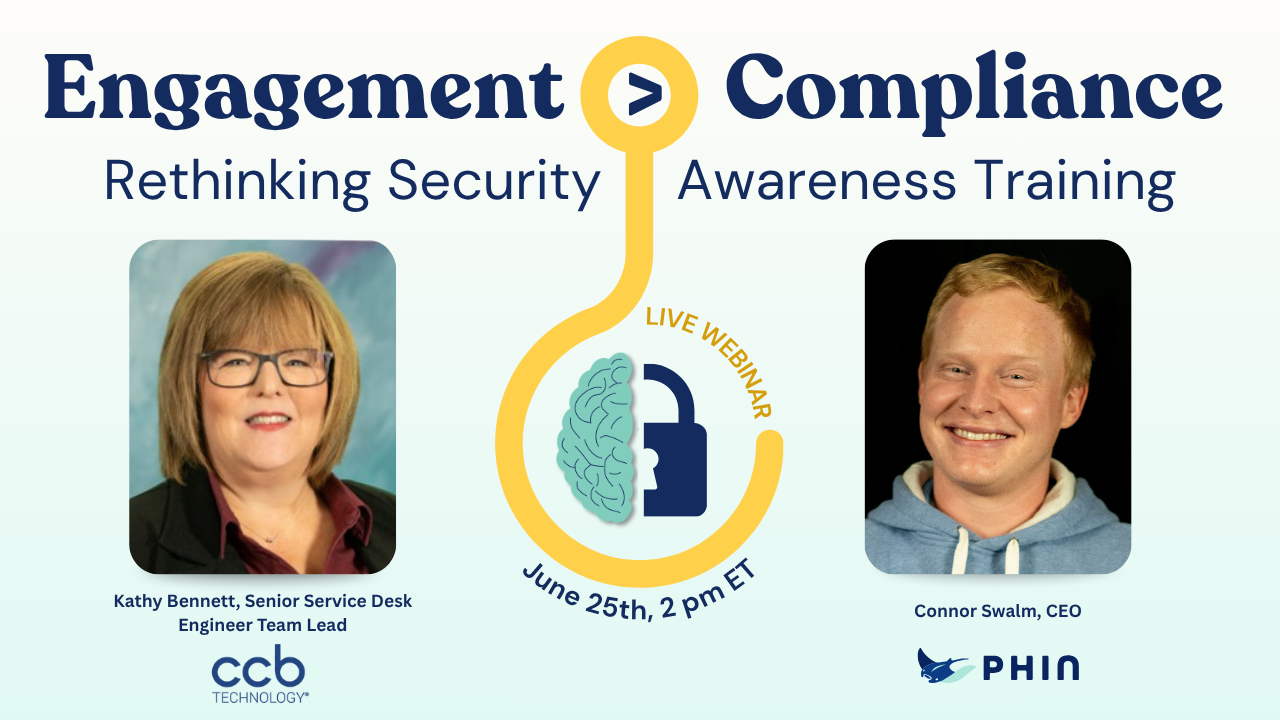
CCB Technology reduces time spent on SAT by over 94% with Phin

JUL 2025 CCB Technology, an MSP serving small to mid-sized businesses, needed a more efficient and user-friendly security awareness training (SAT) solution. Their previous platform didn’t have a pricing model that worked well for MSPs, it presented technical challenges, and took too much time to set up and manage. Seeking a tool that would save time, reduce friction, and drive better client engagement, after a two-year evaluation of multiple providers, CCB Technology chose Phin Security.

Read More